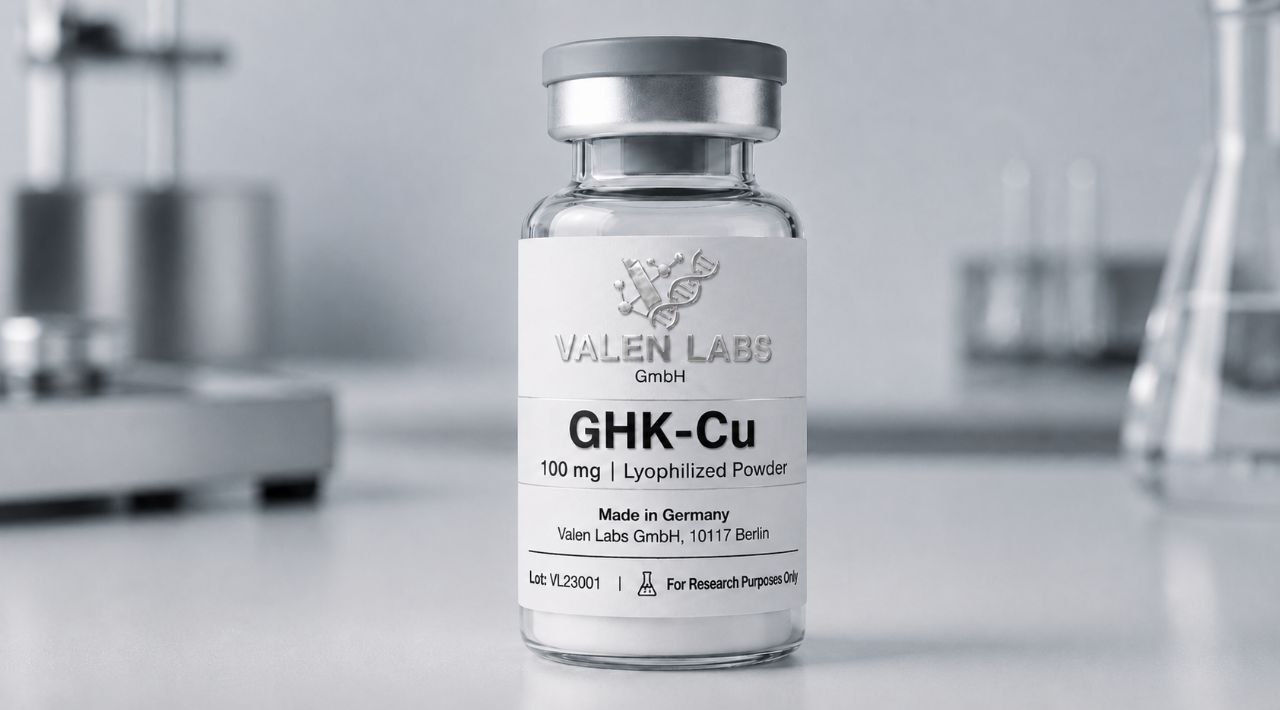
Product usage: This product is intended for research purposes only. Any form of bodily introduction into humans or animals is strictly prohibited. To be handled by qualified professionals only.
🧪 GHK-Cu 50 mg — research peptide targeting skin structure & skin quality
VL-003 · GHK-Cu (Copper Peptide)
In stock — ships within 24h · COA ✓ published per lot
Research use confirmation
✓ Guaranteed safe checkout
1× 50 mg vial + 3 mL bacteriostatic water + 10 insulin syringes + reconstitution card
Open calculator for this compound: reconstitution & dosing calculator
Testing & Lot
tested <6 moCurrent lot: VL-GHK-5B122
Purity: 99.20% · Measured: 49.6 mg · Tested 2026-06-05
Janoshik Analytical s.r.o. · Task #192880
Description
GHK-Cu (copper peptide) is the GHK tripeptide bound to copper — a peptide that occurs naturally in the body and declines with age. It is a central research object in studies of collagen synthesis, skin quality, cell communication and tissue remodelling.
🔬 Product information at a glance
| Name | GHK-Cu (Copper Peptide) |
| Quantity | 50 mg |
| Form | Lyophilized powder · vial |
| Purity | ≥ 99% (HPLC) |
| CAS | 49557-75-7 |
⚗️ What is GHK-Cu being investigated for?
- Skin structure & skin quality
- Cell renewal & tissue processes
- Connective tissue & matrix support
- Biological processes associated with ageing
- Collagen-synthesis pathways
🧬 Stacking notes
In skin-and-tissue research GHK-Cu is regularly studied alongside BPC-157 (tissue repair), TB-500 (cell migration) and KPV (inflammation) — the four components of the GLOW blend.
📦 Packaging & storage
Lyophilized powder in a sealed vial, shipped in neutral, cooled packaging. Store cool (2–8 °C), dry, protected from light; refrigerate after reconstitution; −20 °C for long-term storage.
⚠️ Important
For research purposes only. Not suitable for human or animal use. Not intended to diagnose, treat, cure or prevent any disease.
💉 Dosing & reconstitution reference
Reconstitute with bacteriostatic water — swirl gently, do not shake. Research protocol references: 1–2 mg per day, cycled. Educational reference for laboratory use only.
Educational reference for laboratory reconstitution only — not medical advice. Use the calculator for exact draws.